The Growth Segment Most Lenders Still Misunderstand
Across Jakarta, Manila, Mexico City, Bogotá, and São Paulo, millions of consumers are earning stable income, using digital wallets, and transacting online, yet remain invisible to traditional credit systems.
These are New-To-Credit (NTC) customers who represent one of the fastest-growing lending segments globally, and one of the hardest for legacy underwriting models to assess accurately.
Traditional bureau-based systems were built for borrowers with long repayment histories. They struggle to answer the questions that increasingly matter in NTC lending.
For example, lenders need to know if an identity can be trusted, if a user's behaviour indicates financial stability, and if repayment intent is visible before formal credit history exists
This is why lending to first-time buyers (NTC) isn't just about expanding access anymore. It has become a race to make smart risk choices in real time.
Digital ecosystems already generate enormous volumes of behavioural, transactional, and identity data. The gap now lies between what customer behaviour reveals and what traditional systems can interpret fast enough to support growth without increasing fraud exposure.
What Makes NTC Different From Traditional Borrowers?
Traditional lending runs on a simple assumption: past repayment predicts future risk. NTC customers break that assumption immediately because there's no repayment history to evaluate.
Without it, lenders tend to land in one of two places. They reject legitimate first-time borrowers out of uncertainty, or they misprice risk and absorb hidden fraud and early-default losses they didn't see coming. Neither outcome is sustainable at scale.
The challenge is not simply missing bureau data. It is whether identity, fraud, behavioural, and credit signals can be evaluated together quickly enough to support accurate first-time decisions.
Why NTC Lending Growth Is Accelerating
The NTC segment isn't marginal. It's structural. Around 1.3 billion adults globally remain unbanked, with Indonesia and Mexico among the largest contributors. Even where account ownership has improved, formal borrowing still lags well behind everyday financial activity. Millions of consumers are now digitally visible but remain credit invisible.
For lenders, this shifts where competitive advantage actually comes from. Instead of expanding existing prime borrower segments, the goal is now about evaluating previously invisible customers more accurately than your competitors can.
The infrastructure to do this has also changed.
Apps, digital wallets, instant payment networks, and online shopping platforms now leave a non-stop trail of behavioural and transaction data.
Research consistently shows that bureau-only models systematically exclude underserved consumers and MSMEs in markets where formal credit histories are thin or absent.
Alternative data is no longer a supplementary input. In many NTC environments, it is becoming the foundation of lending decisioning itself. This fundamentally changes what lenders are evaluating during underwriting.
For a deeper breakdown of how alternative data supports lending approvals, see Alternative Credit Scoring for Better Credit Decisioning.
How NTC Lending Changes Risk Decisioning
The move from thick-file lending to NTC lending is not incremental. Traditional underwriting evaluates past repayment history. By contrast, NTC decisioning must evaluate real-time customer behaviour.
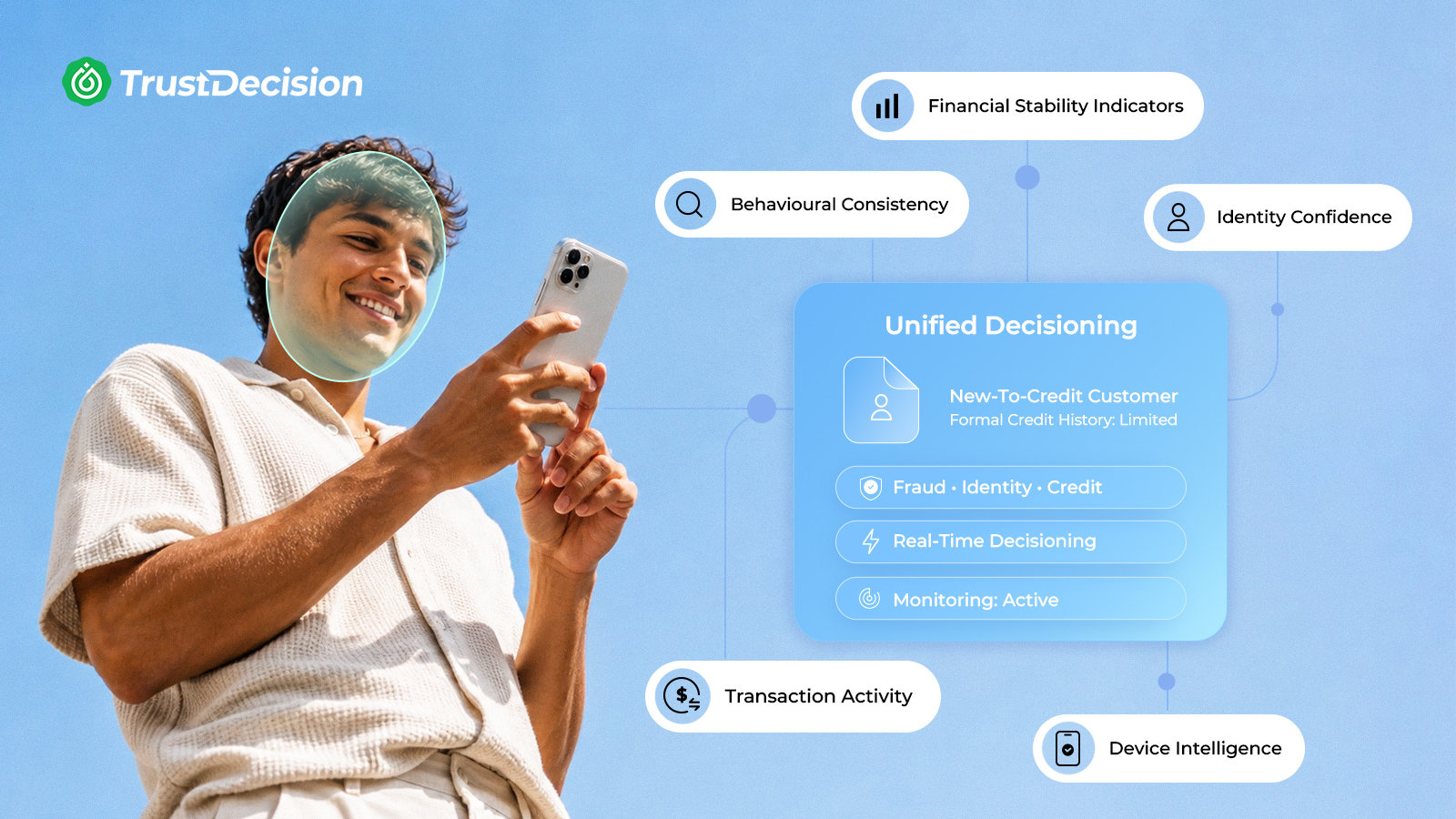
In practice, this changes what you're actually evaluating. Instead of relying on repayment history, smart decisioning depends on identity confidence, behavioural consistency, transaction activity, device intelligence, and financial stability indicators.
While these signals exist, they require a different infrastructure to process.
What Actually Changes in NTC Underwriting
Identity Becomes the First Decision
Without bureau anchoring, identity has to be validated independently through documents, biometrics, device intelligence, and cross-platform consistency checks. Identity is no longer assumed. Instead, it becomes the foundation of the entire decision process.
Fraud Moves Upstream Into Approval Flows
NTC portfolios are more exposed to synthetic identities, first-party fraud, coordinated abuse, and loan stacking. That means fraud evaluation has to happen before credit approval; rather than after.
In thick-file portfolios, repayment history often masks weaknesses in identity confidence or behavioural visibility. In NTC lending, those gaps surface immediately.
Alternative Data Becomes Core Infrastructure
Lenders replace traditional repayment history with operational visibility, which includes monitoring wallet activity, transaction consistency, behavioural stability, device-linked patterns, and digital engagement.
The goal isn't to assess what a customer did in the past. It's to evaluate what their current financial behaviour actually indicates.
Speed Is Part of the Product
NTC customers are comparing lenders on approval speed and onboarding friction. In digital lending, a slow decision isn't just an operational inefficiency; it's a lost conversion.
Speed must be embedded directly into the decision system rather than added later as an operational layer.
Monitoring Becomes Continuous
With less historical certainty upfront, post-onboarding behaviour becomes increasingly important. Repayment activity, behavioural drift, device anomalies, and transaction patterns are all ongoing indicators of changing risk, which means they need to be tracked accordingly.
Where NTC Lending Is Expanding Fastest
The NTC opportunity exists across markets, but the risk dynamics vary significantly by geography.
- Indonesia represents one of the world's largest NTC opportunities, supported by rapidly expanding digital ecosystems. The challenge is fragmented visibility across platforms, which creates exposure to loan stacking, fraud rings, and coordinated abuse that's hard to detect without cross-platform signal sharing.
- Philippines combines lower formal financial penetration with strong mobile engagement. The growth opportunity depends on converting digital activity into reliable lending confidence, a task that requires better identity and behavioural infrastructure than most lenders have built so far.
- Mexico has a fast-growing fintech ecosystem, but fraud patterns have grown more sophisticated alongside it. Identity manipulation, repeat applications across providers, and coordinated fraud are increasingly putting pressure on onboarding systems.
- Colombia and Brazil present different forms of behavioural visibility. Colombia benefits from long-standing telco and utility data usage, while Brazil’s Pix ecosystem has expanded real-time financial visibility significantly. However, this increased visibility also introduces faster fraud velocity, credit cycling, over-leverage, and account takeover risks that require continuous monitoring instead of static underwriting.
Sources: The World Bank, The Global Findex Database 2025, 2025; International Committee on Credit Reporting, The Use of Alternative Data in Credit Risk Assessment, 2024)
How Acquisition Strategy Changes in NTC Lending
Once lenders move beyond bureau-centric underwriting, acquisition strategy changes as well.
The most efficient starting point is an existing ecosystem, such as wallet users, payroll customers, deposit holders, merchants, and existing platform participants. These customers already generate identity visibility, transaction history, device linkage, and behavioural consistency. That lowers both acquisition cost and onboarding uncertainty significantly. The challenge isn't customer access. It's converting existing visibility into accurate real-time decisions.
Open-market acquisition is structurally riskier. Applicants arrive with minimal identity confidence, limited behavioural history, and higher fraud exposure. Decision quality depends heavily on identity verification, application fraud detection, device intelligence, and the ability to detect risk patterns across multiple platforms and lenders in real time.
Without those controls, lenders face the same trade-off repeatedly: they must either suppress growth through aggressive declines or absorb losses through weak approvals.
Why Product Design Changes NTC Risk
NTC isn't a single risk segment. Exposure changes significantly depending on product structure, ticket size, tenure, repayment behaviour, and transaction frequency, meaning each product requires different controls, thresholds, and decision logic.
BNPL (Buy Now Pay Later) depends on instant approvals, strong behavioural controls, and solid first-payment-default management. The primary risk usually isn't affordability. Rather, it is loan stacking across multiple providers simultaneously, which is hard to detect without cross-network visibility.
Microfinance depends more on behavioural cash-flow stability than formal employment. Transactional consistency often outperforms traditional income-based assessments for this segment.
Auto finance introduces collateral, but also significantly larger exposure. That raises the importance of identity certainty, income validation, fraud prevention, and document verification.
All of these elements need to work together, not in sequence. See how global lenders are strengthening onboarding and fraud controls in The Identity Intelligence Mandate: Scaling Global Expansion with LLM-Powered Document Verification.
P2P lending carries a dual responsibility by assessing borrower risk and protecting investor capital. That requires stronger segmentation, fraud controls, continuous monitoring, and platform-level risk visibility than most other product types.
Taken together, these differences highlight a broader shift happening across NTC lending. The challenge is no longer simply approving more first-time borrowers. It is adapting decision logic dynamically according to product structure, fraud exposure, and evolving customer behaviour in real time.
Consequently, separating fraud evaluation from credit decisioning becomes increasingly difficult as NTC portfolios scale.
Why Fraud and Credit Must Be Unified
In NTC portfolios, fraud and credit risk are often inseparable at origination. Synthetic identities can resemble thin-file borrowers. Early financial stress can resemble fraud. The signals overlap in ways separate systems struggle to distinguish accurately.
In thick-file portfolios, repayment history often compensates for weak identity visibility. In NTC lending, those gaps surface immediately. When fraud and credit systems remain disconnected, legitimate customers are declined unnecessarily while fraudulent actors pass through undetected.
Gartner notes that the market is already moving toward consolidated platforms combining identity, fraud, and decisioning as baseline capabilities.
Leading institutions are responding by shifting away from isolated underwriting workflows toward unified decisioning architectures. See Unifying Fraud and Credit Risk Through Decision Intelligence.
The Future of NTC Lending: Unified Decisioning
Once fraud and credit are treated as one connected problem, the operating model changes fundamentally. A scalable NTC decision framework connects identity verification, fraud detection, alternative data ingestion, credit scoring, and post-disbursement monitoring into a single continuous system.
In practice, lenders stop evaluating NTC customers once at onboarding and start tracking them throughout the relationship. Identity confidence, repayment behaviour, transaction activity, and fraud exposure all continue to evolve after approval.
This shifts underwriting from a strict one-time gatekeeper into a continuous safety check.
For a deeper breakdown of this architecture, see How Decision Intelligence Actually Works for Risk Management.
Concluding Remarks: In NTC Lending, Better Decisions Win
NTC growth is accelerating across Southeast Asia and Latin America, but scale alone will not build sustainable portfolios. The lenders most likely to outperform will not simply approve faster. Instead, they will understand customer risk more accurately from the very first interaction.
That requires more than bureau expansion or alternative scoring models. It requires connected decisioning across identity, fraud, behavioural, and credit workflows built directly into the lending infrastructure itself.
In NTC lending, competitive advantage no longer comes from borrower access alone. It comes from making better first-time decisions at scale.
To scale NTC portfolios without increasing fraud losses or early defaults, speak with TrustDecision's specialists about building unified decisioning into your lending architecture.
References:
Gartner, Emerging Tech: The Future of Online Fraud Prevention. 2025.
International Committee on Credit Reporting, The Use of Alternative Data in Credit Risk Assessment, country practices section, 2024.
The World Bank, The Global Findex Database 2025: Connectivity and Financial Inclusion in the Digital Economy, 2025.