
Many fraud systems already collect enough signals to see an attack, but not always in a way that helps them act on it. Device fingerprints, behavior events, and business outcomes often sit in different parts of the risk workflow, and when these signals are evaluated separately, isolated signals can make the pattern look smaller than it really is. The harder question is: when attackers keep switching devices, networks, accounts, environments, and scripts, can the system still recognize the risk and apply the right action in the right business scenario?
To answer that, this article looks at three layers of the problem:
- How device fingerprinting helps fight device and environment spoofing
- How behavioral signals expose automation and abnormal user journeys
- What businesses can do when device fingerprinting and behavioral signals are combined across the user journey
Defense at the Device Fingerprint Layer
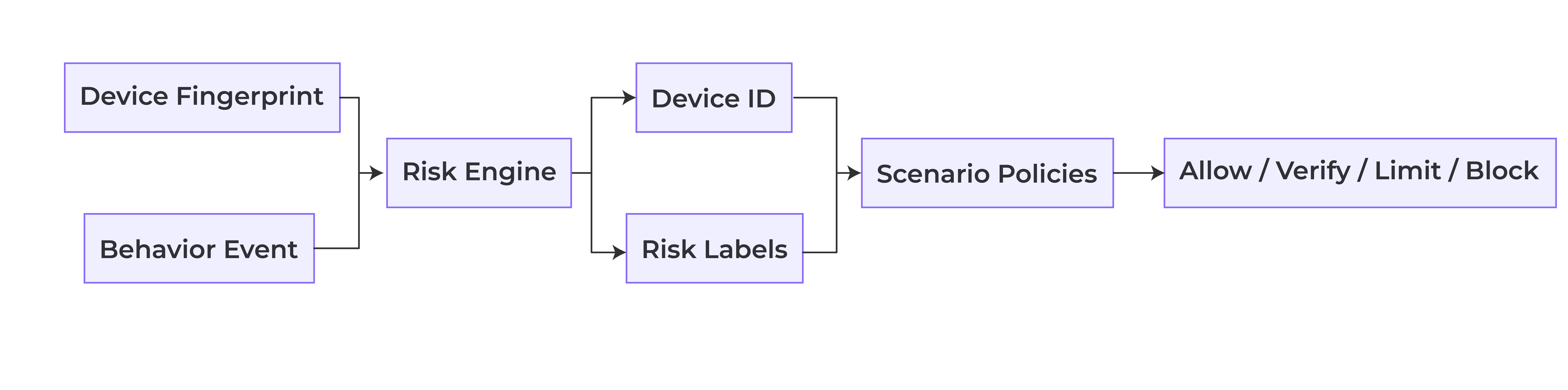
At the device layer, the attacker is not trying to defeat a single field. The goal is to break continuity. If the same machine can return as a different device, or a compromised environment can pass as an ordinary one, every account, session, and transaction becomes harder to place in context.
Device fingerprinting helps restore that continuity by collecting signals from the browser, device, app, operating system, and network environment. These signals show whether an action comes from a stable environment, a manipulated environment, or an environment that keeps changing to avoid recognition.
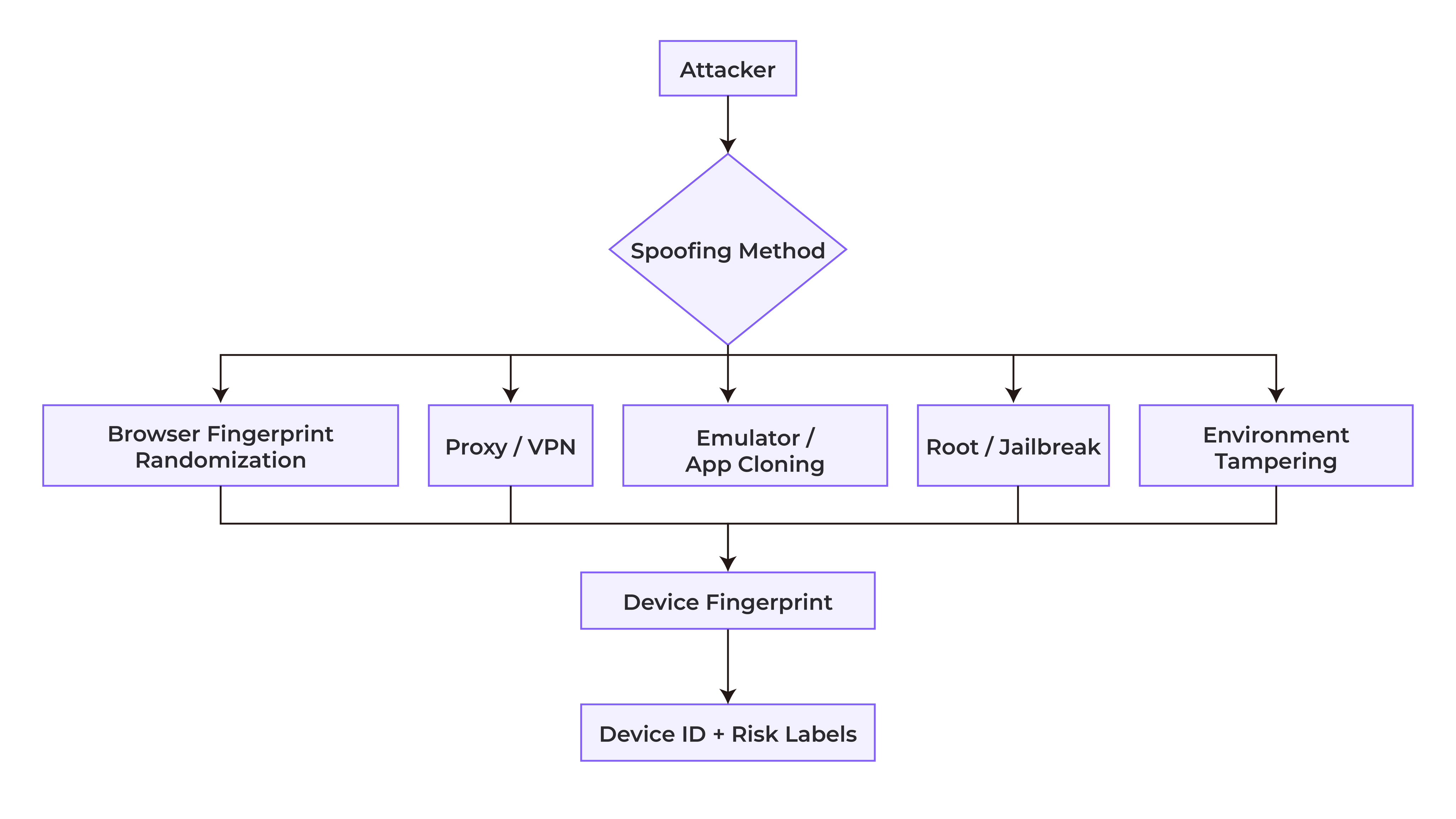
The spoofing method may come from different layers of the environment. On the web, attackers may randomize browser fingerprints, rotate proxies or VPNs, use anti-detect or headless browsers, or manipulate attributes such as User-Agent, Canvas, WebGL, fonts, timezone, and language. On mobile, the same logic appears through emulators, app cloning, multi-instance apps, root or jailbreak status, API hooking, modified device parameters, repeated reinstallations, cache clearing, or device resets.
The key is not to overreact to one field. A single signal often creates false positives. Signal combinations are what matter.
Once these combinations become consistent enough to describe the environment, they can be translated into device-level risk labels. These labels give the policy layer a clearer language for understanding what kind of device risk is present before deciding whether to allow, verify, limit, or block the action.
A device ID does not need to identify the same device with perfect certainty. Its job is to shift the cost curve. Attackers can spoof, but the more they spoof, the less natural the environment becomes. The less natural it becomes, the easier it is for risk labels to accumulate.
Defense at the Behavioral Layer
Device fingerprinting answers questions like “who is this likely to be,” “where is it coming from,” and “does the environment look trustworthy.” Behavioral collection answers a different question: “how is this user acting?”
Many attacks look subtle at the device layer but mechanical at the behavior layer. For example, you may find sessions move through pages too quickly, repeat the same path across accounts, submit forms at fixed intervals, or create concentrated failures around login, CAPTCHA, payment, or API call—the sequence is often where the pattern becomes visible.
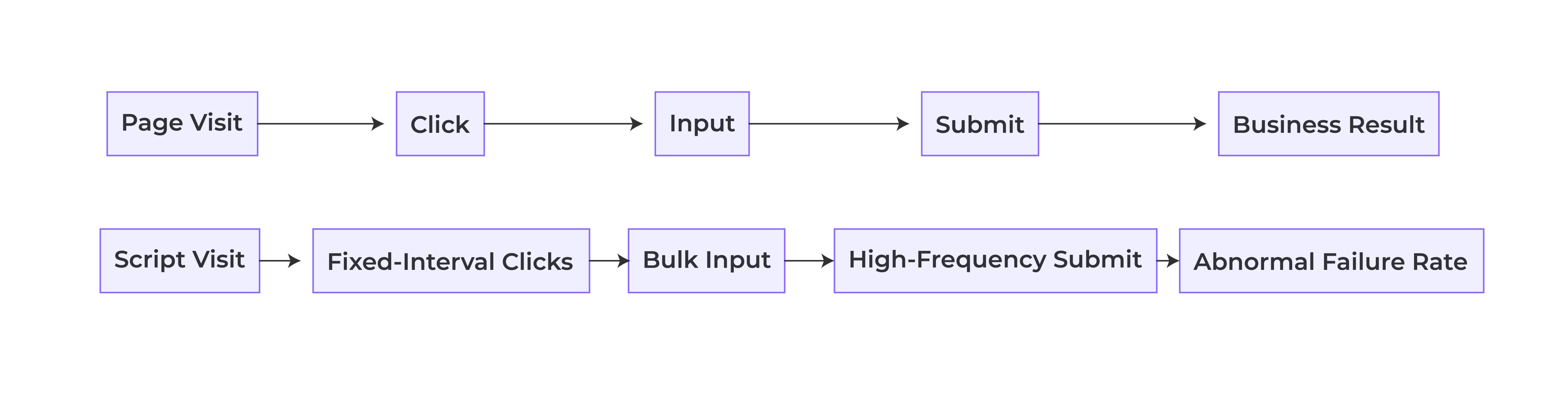
Behavioral events in each stages across the user journey is important for understanding the high-risk / fraudulent patterns:
The key is to look beyond single actions. Attackers can simulate clicks, adjust dwell time, or copy parts of a normal journey. What is harder to sustain is natural variation across many accounts, sessions, and outcomes. When the same path, rhythm, or failure pattern appears repeatedly, behavioral signals start to describe automation, probing, bulk activity, or resource abuse.
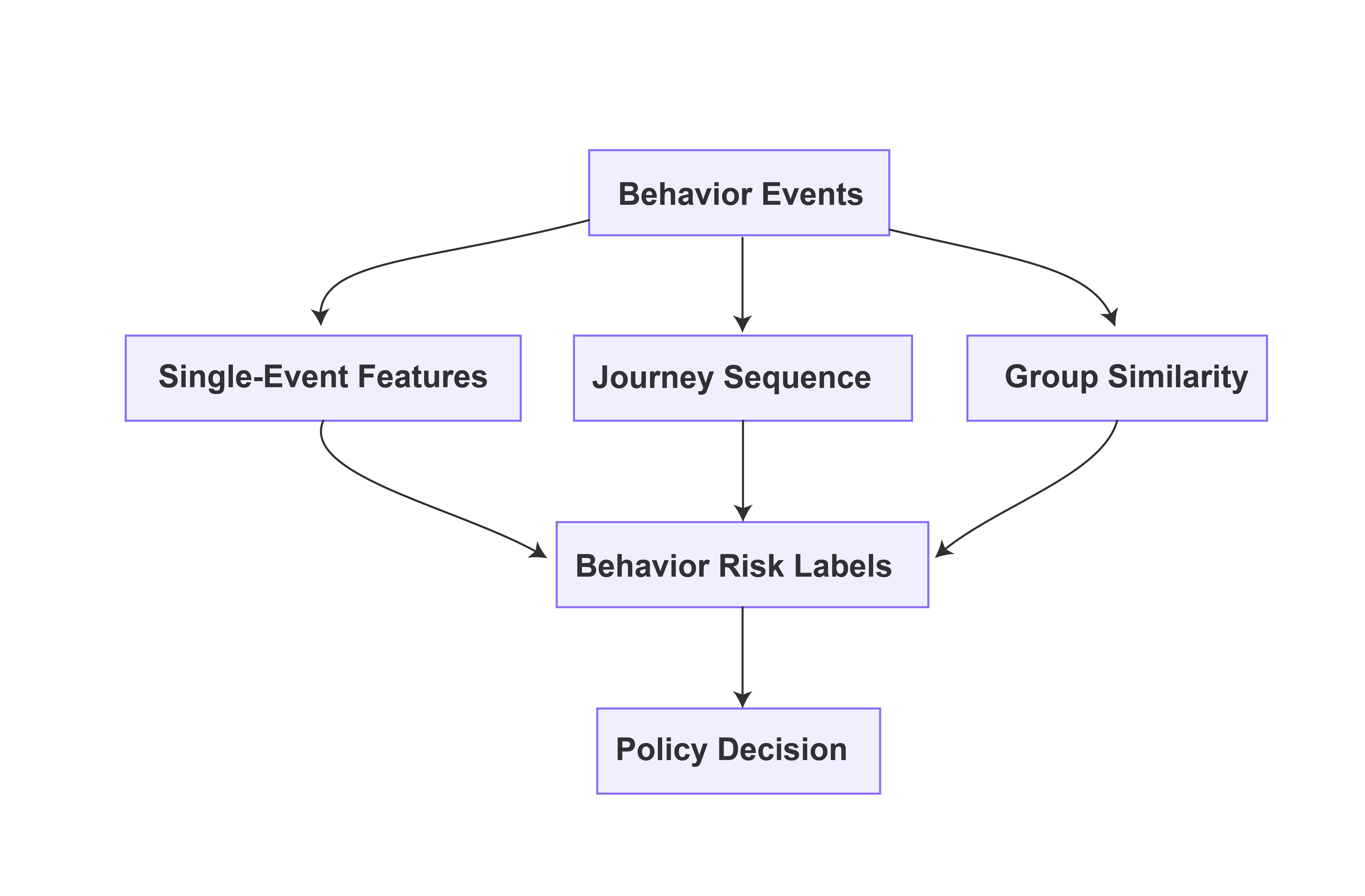
Examples of behavior risk labels include:
Connect Device IDs with Behavioral Identity
Looking only at devices misses that move slowly enough to stay below device-level thresholds.. Looking only at behavior misses attacks that rotate accounts and IPs. That is where the signals need to meet. A better approach is to put device ID, account ID, IP, behavior sequences, and business outcomes into the same risk profile.
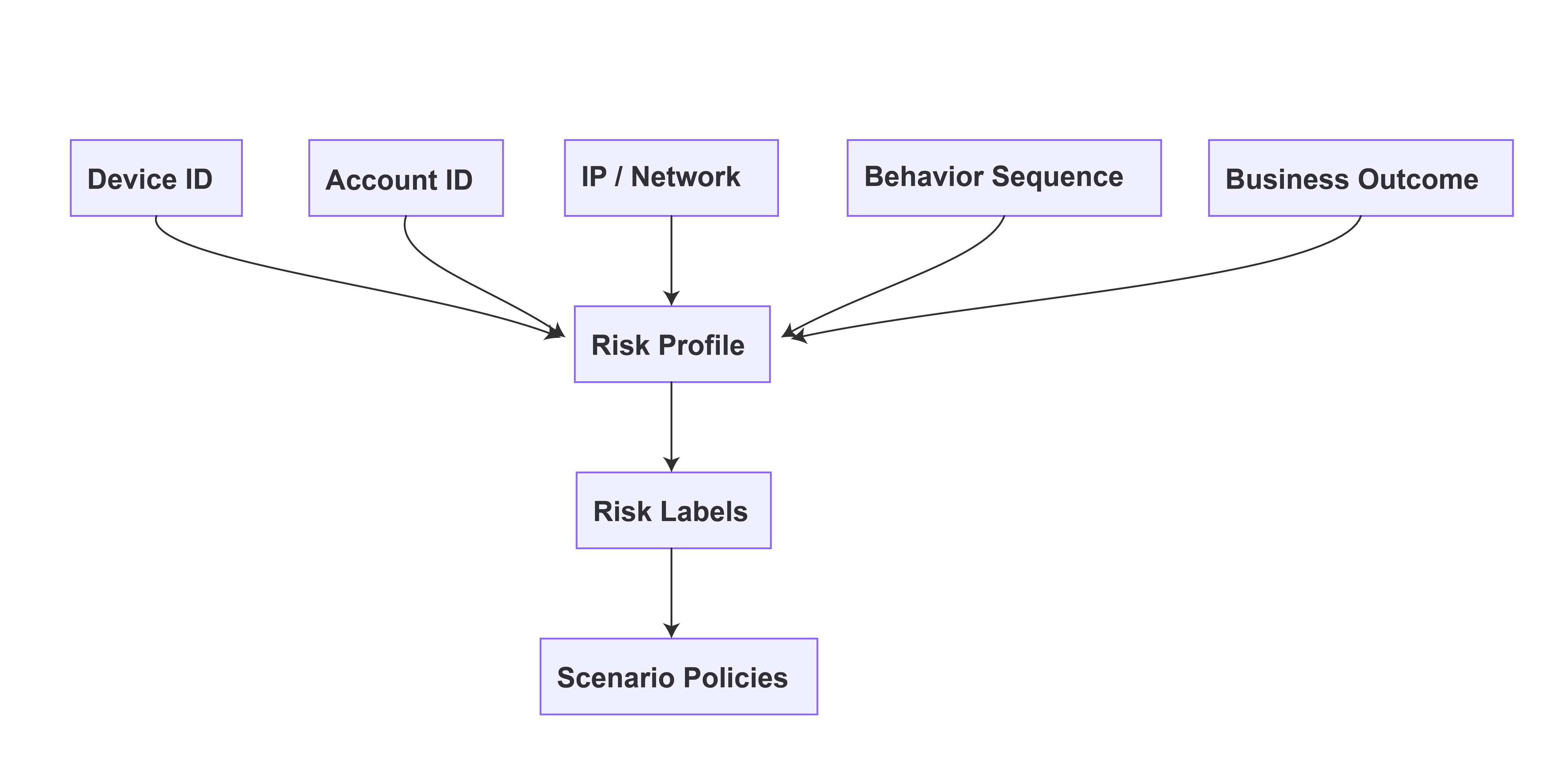
Once these signals are connected, the system can start reading relationships that would be easy to miss in isolation. For example:
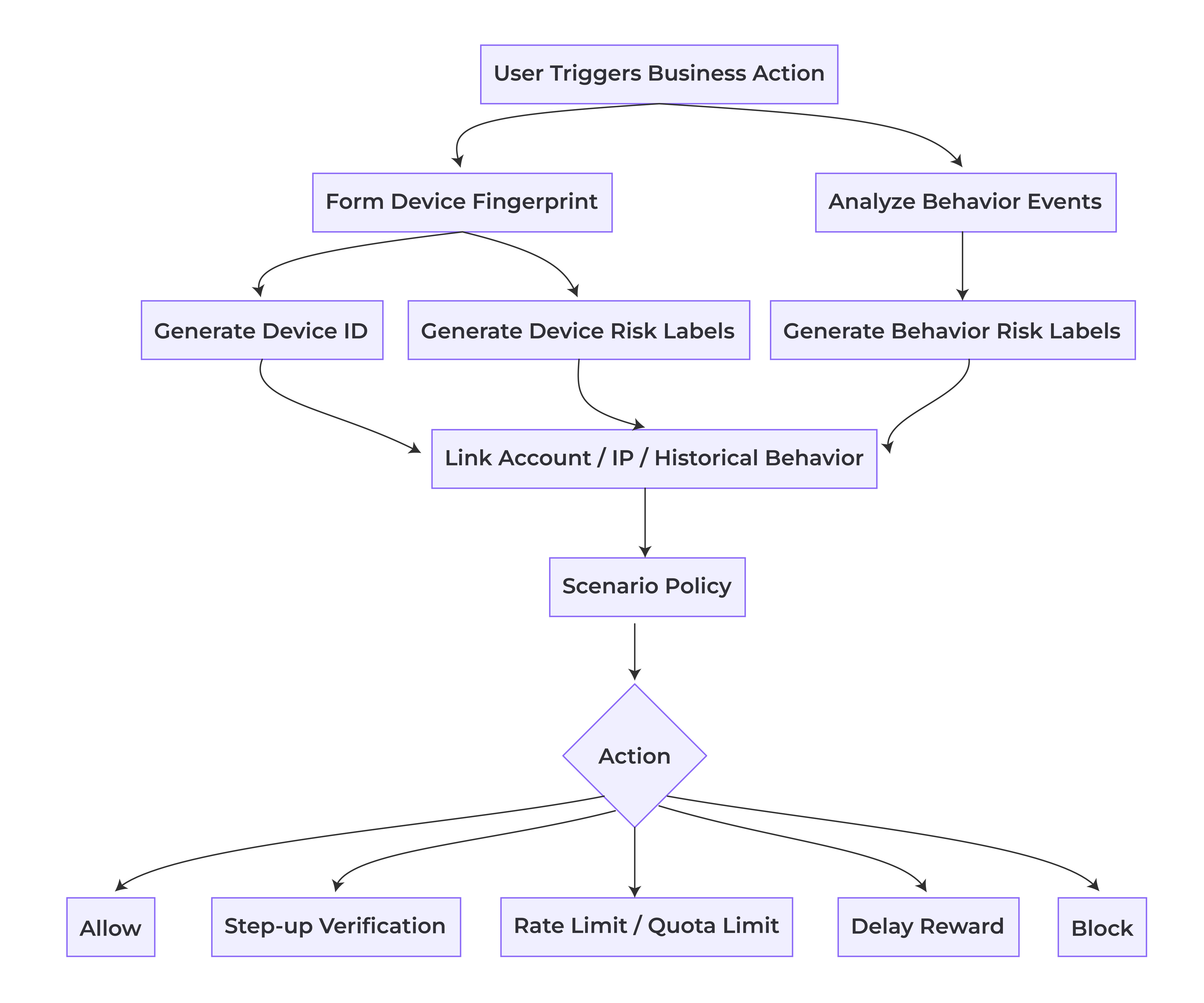
Once these relationships are visible, the next step is deciding how much friction the action deserves. A related device cluster, repeated journey, or shared account pattern does not carry the same weight in every context. The response depends on what the action can lead to: a new account, unauthorized access, reward loss, financial exposure, or resource cost.
Signup: Stop Bulk Account Creation
Signup is where many fraud patterns first acquire scale. Once attackers can produce accounts that look separate and usable, downstream abuse becomes much harder to contain—this is why device and behavior signals matter early in the journey.
The response should follow how credible that separation looks. A normal new-device registration can move through with little friction, while repeated device traces, shared behavior paths, or manipulated environments may call for verification, rate limits, or blocking.
For examples:
Login: Prevent Unauthorized Access
The goal of login fraud detection is to understand what the login attempt is becoming. A normal user may login to change devices or locations, but credential attacks usually leave pressure on the system: repeated failures, many accounts touched by the same device, or a successful login that quickly moves toward changing account settings or moving value.
This is why login policies need to combine device familiarity and access behavior. When the pattern still matches the user’s expected context, the journey can stay low-friction. When access starts to look tested, distributed, or newly controlled, the system should add verification, slow the attempt, or block it.
Promotions: Minimize Reward Abuse
Promotion abuse starts when campaign incentives become something that can be claimed at scale.Device and behavior signals help show whether reward claims are coming from real users, or from repeated participation built on the same device, environment, referral structure, or behavior path.When these links appear before rewards are issued, the response can be adjusted without treating every participant the same way. For example:
Transactions and Payments
Payment is where weak signals become expensive. A high-risk device may first be used to bind a payment method, then move into fraudulent third-party payment, fake transactions, or bulk refunds.
This is why device risk needs to be read with payment context, including transaction value, payment method, shipping information, account history, and recent behavior.
Content, Resource, or API Consumption
Not every abuse case ends in a payment loss. For products that carry usage costs, fraud can show up as quota draining, repeated API calls, or automated consumption of expensive resources. The risk is that many accounts may look lightweight on their own, while collectively consuming far more than a normal user pattern would justify. In this context,device and behavior signals help decide how much access a new or risky pattern should receive.
Closing Thoughts
Fraud rarely stays where it first appears. Early signals may look limited to one part of the journey, but the real damage often comes from how those signals carry forward into later actions.
Device fingerprinting and behavioral signals help connect those shifts early enough to support action. When separate traces begin to describe the same abuse, the risk system can respond with the right level of friction before the pattern matures. That is how device fingerprinting and behavioral signals work together: by turning scattered traces into earlier, more precise fraud decisions.
Get Free Trial of Device Fingerprint on AWS Marketplace.



.jpeg)
.jpeg)