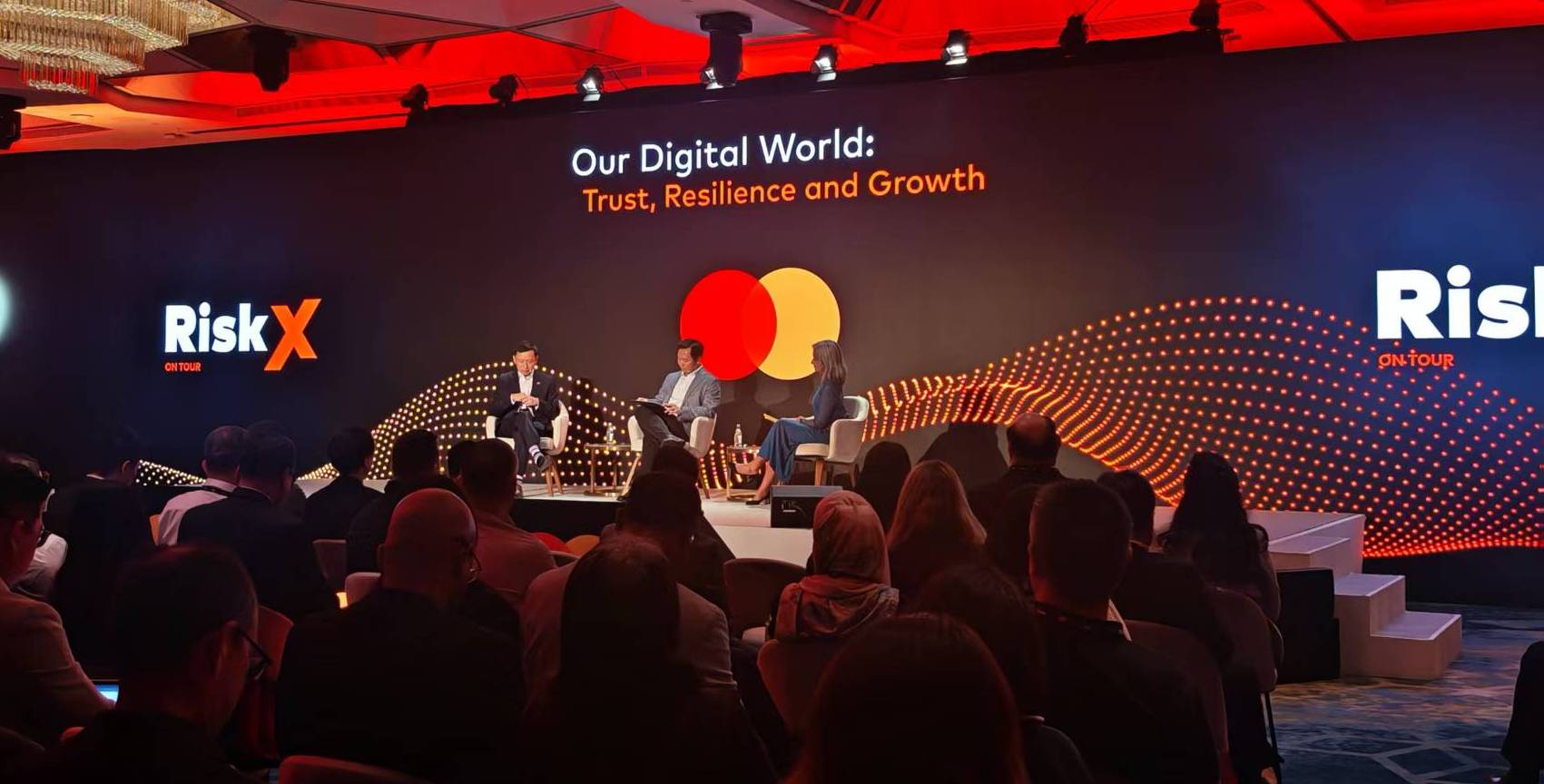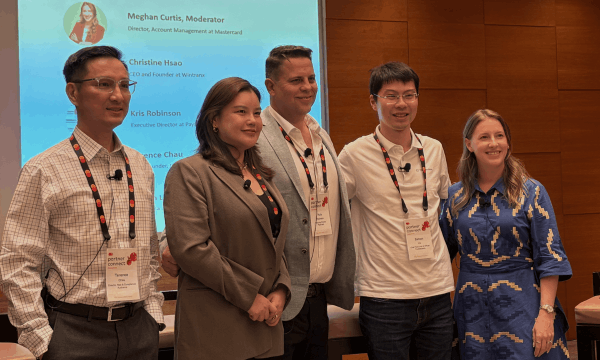
SINGAPORE, 19 May 2026 — Mastercard’s Partner Connect 2026 brought the Asia Pacific payments ecosystem together this week, and TrustDecision was on stage as part of the conversation. Senior leaders of financial services, technology providers and Mastercard’s services team shared notes on how fraud is evolving, and how the industry intends to stay ahead of it.
Dr. Simon Liu, Chief Data and AI Officer at TrustDecision, spoke in the panel “Fighting Fraud Without Friction: Real-World Strategies from the Ecosystem,” moderated by Meghan Curtis, Director of Channel Partnerships at Ethoca APAC. Over 45 minutes, the panel kept returning to one question:
“How does the industry stop fraud without slowing down the customers it most wants to keep?”
That, increasingly, is the central design problem in modern risk.
From Visible Friction to Silent Verification
The 1st reframing came down to friction itself. Historically, without rich data or modern modelling, the safest play for fraud teams was to interrupt the customer and ask for additional verification. Friction was the price of safety.
With broader behavioral data and more sophisticated models, that calculus has shifted. The work of modern verification now happens silently in the background, in the milliseconds the customer never sees. Friction is reserved for the cases that genuinely warrant it.
To the legitimate customer, modern fraud prevention is becoming invisible. To the business, the shift translates into higher approval rates, fewer false positives, and a measurably better journey from first touch through to repeat purchase. Customer experience and fraud management, long treated as a trade-off, are now optimized together.
The Quiet Architecture Shift Inside Modern Risk Models
The 2nd reframing came down to how risk decisions are made. The most common question Dr. Simon receives is how Large Language Models (LLM) apply to payment risk. In their literal form, LLMs play a smaller role than the headlines imply. The real breakthrough is the architecture behind them: the ability to model sequential data reliably and at scale.
For years, risk models were built on static, aggregated features. Counts, sums, ratios at a single point in time. By capturing behavioral sequences across user sessions and applying the foundational techniques that power modern language models, risk teams can now read intent the way a language model reads a sentence. The result is a generation of risk-scoring models markedly more accurate against the slow, patient, multi-step fraud that static features were never designed to catch.
“The breakthrough isn’t the language model itself. It’s the ability to model behavioral sequences across user sessions, and to reason about intent the way a language model reasons about a sentence. — Dr. Simon Liu, Chief Data and AI Officer, TrustDecision”

Why No Single Participant Solves Modern Fraud Alone
The 3rd theme of the panel was ecosystem collaboration. Dr. Simon framed it as a stack of overlapping vantage points. A merchant sees its own customers. A risk solution provider sees patterns across many merchants and many regions. A network like Mastercard sees a global layer that no individual participant can reconstruct alone. Each layer answers a question the layer below it cannot, and the most accurate real-time decision draws on all three.
Moving beyond theory, this is the new reality of fraud decisioning. In high-stakes, real-time markets, companies face industrialized fraud syndicates and must deliver near-frictionless customer journeys without compromising defense."
“Merchants see their own data. Risk providers see across merchants and regions. Mastercard provides the global layer. Modern risk solutions are built by combining all three.” — Dr. Simon Liu
Where the TrustDecision–Mastercard Partnership is Heading
Fraud prevention is no longer a competition of who has the best individual technology. That technology is increasingly broadly available. Advantage now lives in how data, modelling, and ecosystem signals are combined, and in the partnerships that close the loop between merchant intelligence, cross-regional patterns, and global network visibility.
The next phase of collaboration between TrustDecision and Mastercard sits at this intersection. By combining TrustDecision’s cross-merchant and cross-regional behavioral intelligence with Mastercard’s global network signals, the partnership is positioned to support more merchants, issuers, and digital platforms in delivering decisions that are faster, more accurate, and less intrusive. Across identity, fraud, dispute resolution, and the broader infrastructure that underpins global digital commerce and platforms.
The next decisive shift in fraud prevention is the operating model itself. From rules to behavioral sequences. From interruption to silent verification. From siloed defense to layered ecosystem decisioning. The organizations that treat each as parallel investments, rather than a sequence of upgrades, will define what good looks like for the years ahead.