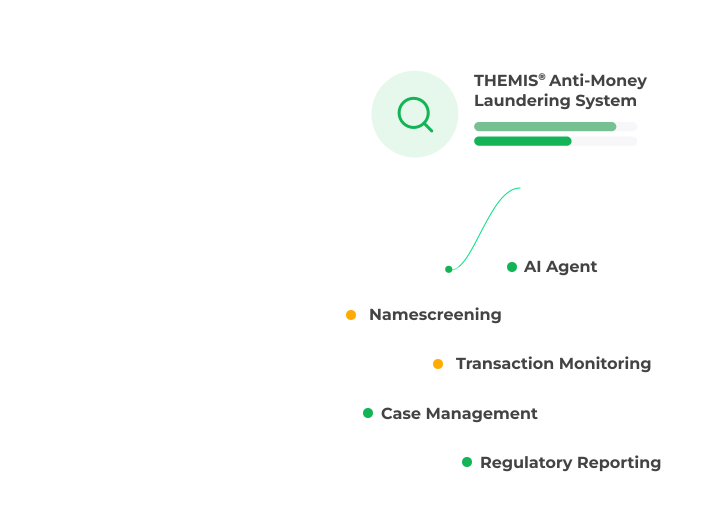
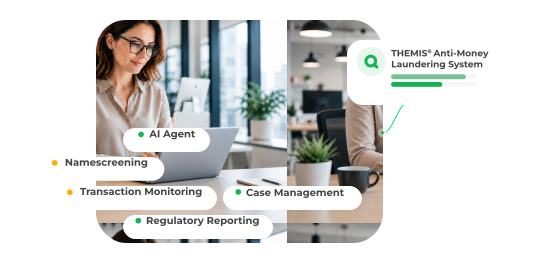
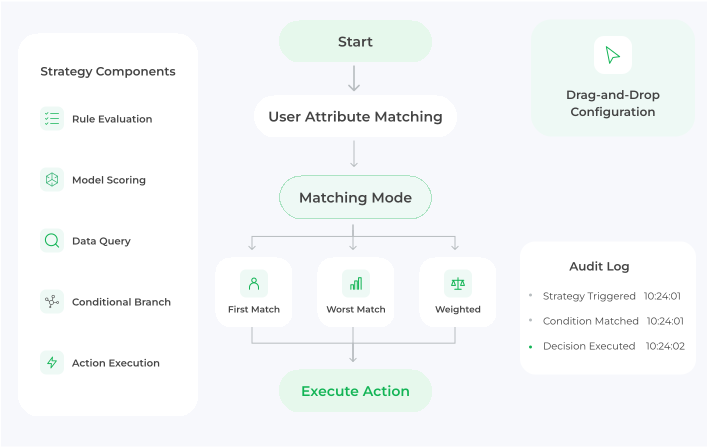
Build and tune transaction-monitoring scenarios, screening rules, CDD risk-rating thresholds, and alert workflows within a drag-and-drop policy studio — no coding required. Back-test all changes against historical data prior to release, and maintain a complete audit log detailing what triggered, when and why.
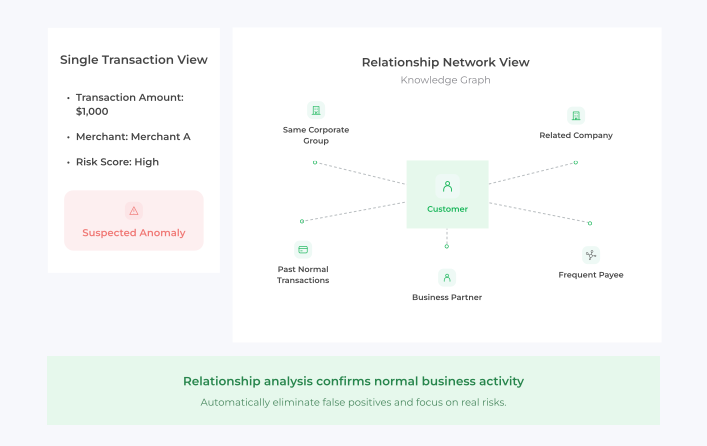
Screen customers and related parties against sanctions, PEP and adverse media lists using exact, fuzzy, phonetic and transliteration matching for English, Cantonese and Chinese names. Knowledge-graph relationship analysis distinguishes genuinely suspicious networks from legitimate business activity, filtering false positives before they are routed to analysts.
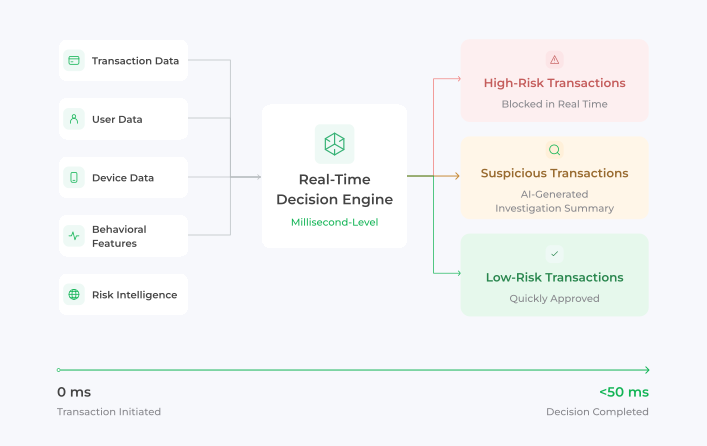
A proprietary engine completes screening and risk scoring in under 50 ms at 10K+ TPS with 99.99% availability. Policies, rules, scorecards, models and real-time indicators run together across payments, transfers and account opening — moving AML controls from post-event review to in-transaction interdiction where regulation allows.
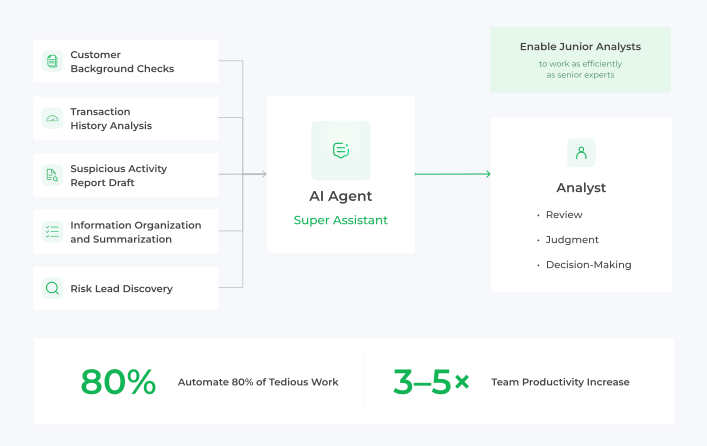
AI Agents gather transaction history, customer profile and network evidence, draft the investigation summary, recommend next actions and prepare the suspicious activity narrative. Analysts review, adjust and approve — routine review drops from hours to minutes and team capacity increases 3–5x.
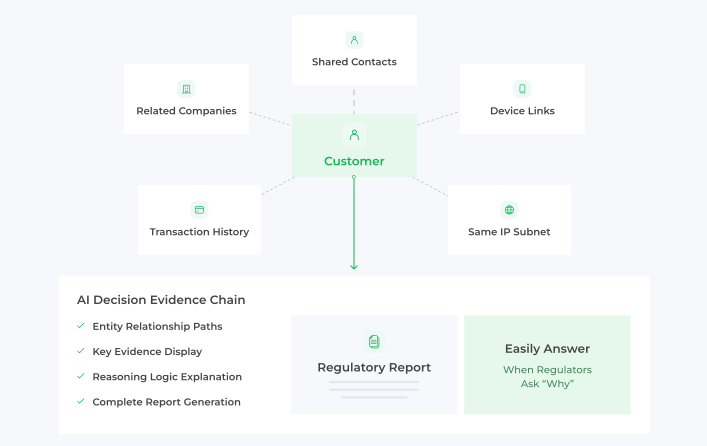
Each screening hit, alert, model score and case decision carries a complete evidence chain: which rule fired, which relationships mattered and how the outcome was reached. Generate STR/CTR reports on demand, retain 10-year WORM-grade records, and enforce four-eyes review, RBAC and full operation traceability.
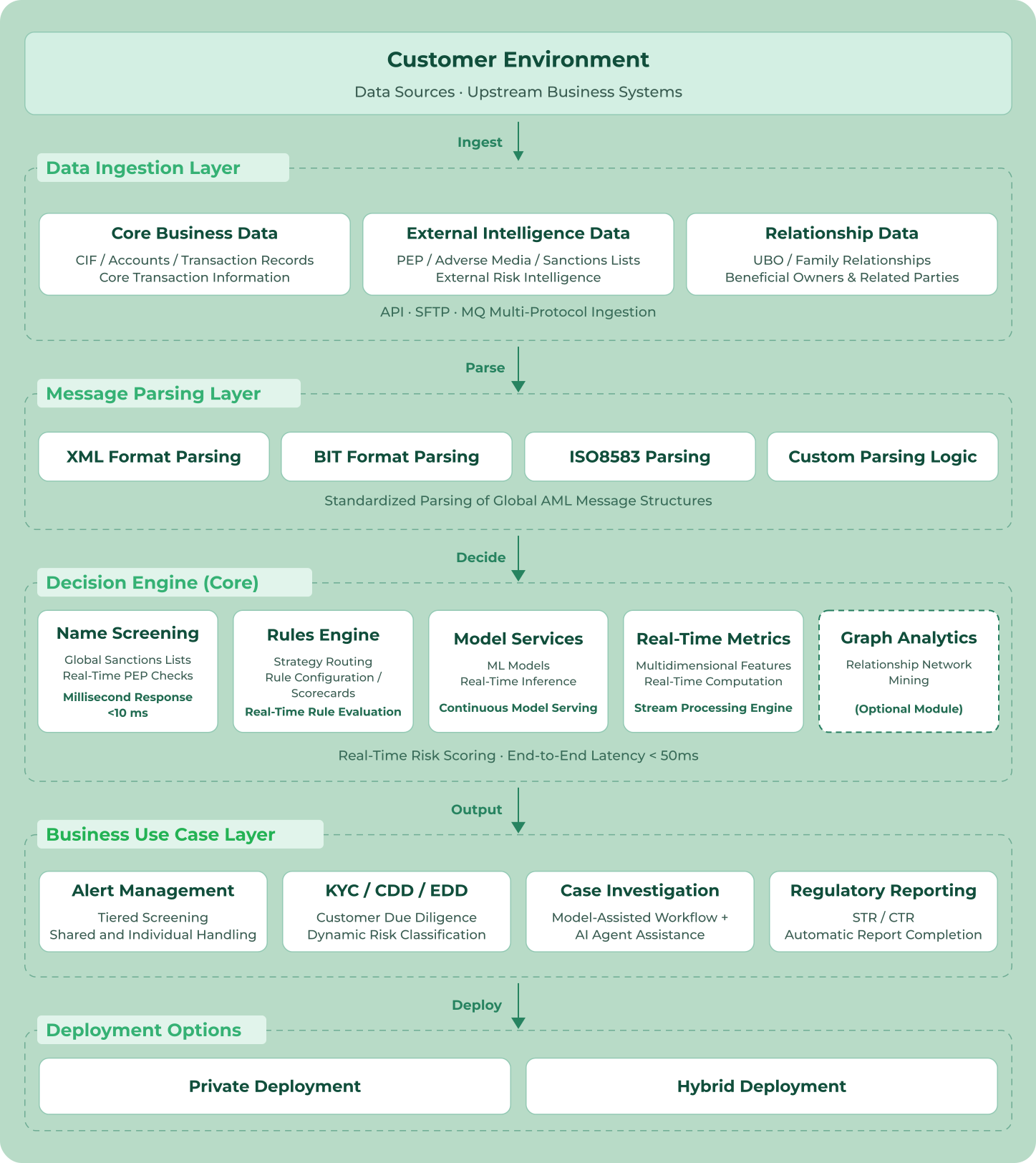



The key differences between THEMIS® and other traditional international vendors are mainly reflected in the following three dimensions:
It is suitable for commercial banks, digital banks, e-wallet / payment institutions, insurance companies, and other financial institutions. Beyond traditional AML scenarios, it also covers scams, mule accounts, account takeover, real-time payment fraud, and emerging digital banking crimes. Through FRAML convergence, it enables unified identification of fraud and money laundering risks.
Yes. The product is designed with an emphasis on localized rules, regulatory requirements, and payment scenario adaptation. Currently active in the Philippines, Malaysia, Hong Kong, and Singapore, with the ability to rapidly respond to regulatory characteristics of emerging markets across Southeast Asia and Latin America.
Three deployment models are supported:
Three methods are supported: API (real-time interface), SFTP (batch file transfer), and MQ (message queue). This covers service integration management, field grouping / field management, API service configuration, third-party data management, and external intelligence / list integration.
Yes. The Decision Center provides comprehensive policy management capabilities — scenario policies, rule sets, scorecards, decision tools / function libraries, rule immunization, and strategy lab (policy testing, rule set testing, decision analysis) — all supporting self-service configuration.
The product is designed in accordance with FATF international standards, with a complete AML architecture, workflow, and operational logic. It has already gained regulatory recognition in markets such as the Philippines. All modules feature comprehensive audit trails and full operation traceability.