Key Takeaways
- Credit risk is the chance of borrower default or declining credit quality. It affects lenders, businesses, and investors, and becomes more severe during economic or interest-rate stress.
- Credit risk management protects lenders from borrower default, credit deterioration, and concentration risk while strengthening portfolio resilience and capital stability.
- Effective Credit Risk Management Strategies combine credit scoring, financial statement analysis, diversification, loan covenants, and continuous credit monitoring to reduce exposure and improve portfolio quality.
- AI-powered credit risk platforms support model development, risk quantification, and early-warning detection, enabling faster, more consistent, data-driven lending decisions while staying compliant with Basel III, IFRS 9, and regional regulations across APAC, MENA, and LATAM.
- TrustDecision’s Credit Risk Management platform delivers high-precision, stable scoring, broad data coverage, automated workflows, and integrated KYC/AML screening, enabling faster, safer, and more transparent credit decisions across markets.
Understanding Credit Risk
What Is Credit Risk and Why Does It Matter?
Credit risk is the possibility that a borrower cannot meet repayment obligations, resulting in financial loss. It affects banks, corporations, and investors across the financial ecosystem.
Key Forms of Credit Risk:
- Default Risk: When a borrower cannot repay loan principal or interest, leading directly to losses for lenders.
- Concentration Risk: Excessive exposure to a single borrower, sector, or region; if that segment weakens, the entire portfolio is affected.
- Credit Migration Risk: A borrower’s credit quality deteriorates over time, increasing the likelihood of downgrades and future default.
Global banks faced rising credit-risk pressure in 2023, with credit losses increasing 16% year-over-year amid higher rates and macroeconomic uncertainty — all of which have pushed banks to strengthen their provisioning strategies.
Source: S&P Global – Global Banks: Our Credit Loss Forecasts
What is the Impact of Credit Risk?
- Financial Institutions: Poor credit performance weakens capital buffers, increases regulatory pressure, and limits lending capacity.
- Businesses: When customers or partners delay payments or default, it disrupts cash flow, heightens liquidity risk, and slows business performance.
- Investors: Credit downgrades or defaults reduce asset valuations and increase volatility across bond portfolios. This challenge is especially prominent in regions with rising household leverage, such as APAC, tightening regulatory environments in EMEA, and expanding digital credit adoption in LATAM.
What Is Credit Risk Management?
Credit risk management is the process of identifying, assessing, and mitigating the likelihood of borrower default or credit deterioration. Banks and financial institutions increasingly rely on AI-powered credit risk management solutions and advanced analytics platforms that support model development, risk quantification, and regulatory compliance.
Its purpose is to protect financial stability, support sustainable lending practices, and ensure alignment with global and regional regulatory standards.
Core Objectives of Credit Risk Management:
- Assess Exposure: Measure the probability of default and potential loss severity.
- Strengthen Portfolio Quality: Balance growth with prudent risk appetite and sound underwriting.
- Maintain Compliance: Align with Basel III, IFRS 9, and supervisory guidelines across global markets.
- Enhance Resilience: Safeguard capital and liquidity during economic uncertainty or market stress.
Modern credit risk management solutions help institutions operationalise these objectives using data-driven scoring, portfolio analytics, and automated monitoring workflows.
With the foundations in place, effective credit risk management depends on applying well-structured strategies that strengthen assessment, monitoring, and long-term resilience.
Credit Risk Management Strategies
How Is Credit Risk Quantified?
Banks and other financial institutions use analytical tools, quantitative models, and scenario simulations to evaluate creditworthiness, measure portfolio exposure, and support informed lending decisions. Many now leverage AI-driven credit risk automation to accelerate decisions while maintaining consistency and regulatory alignment.
For a deeper look at how credit assessment is shifting from legacy models to AI-powered, data-driven approaches, read our in-depth guide: Credit Risk Analysis: From Traditional Methods to Digital & AI-Driven Approaches
a. Credit Scoring Models
Credit scoring models are effective tools that estimate borrower creditworthiness using behavioral and financial indicators such as:
- Payment history shows whether borrowers meet obligations on time.
- Credit utilization reveals financial strain when usage is consistently high.
- Recent inquiries may signal liquidity stress or aggressive credit-seeking behaviour.
In advanced environments, credit risk management software supports AI-powered credit assessment by analysing thousands of borrower attributes, producing more consistent and explainable score outputs.
These models offer measurable benefits, including faster credit decisions, consistent scoring standards, and improved prediction of potential defaults.
b. Financial Statement Analysis
Financial statement analysis assesses a borrower’s financial health through their balance sheet, income statement, and cash flow statement.
Key Ratios Used:
- Debt-to-equity ratio: Measures leverage and reliance on debt.
- Liquidity ratios (current, quick): Assess ability to meet short-term obligations.
- Interest coverage ratio: Indicates capacity to service existing debt.
Modern analytics platforms enhance this process with data and AI-powered analytics that generate bankruptcy risk scores, credit ratings, and financial statement monitoring alerts in real time.
c. Diversification
Diversification reduces concentration risk by spreading credit exposure across different industries, geographies, customer segments, and risk grades.
Benefits of Diversification:
- Minimises portfolio impact when a borrower or sector weakens
- Buffers against region-specific shocks (e.g., property volatility in APAC, commodity-linked risks in LATAM, sovereign-corporate spreads in EMEA)
- Supports balanced portfolio growth
A diversified portfolio also integrates insights from credit risk management solutions to track exposure and optimise capital consumption.
d. Loan Covenants
Loan covenants are contractual clauses that help lenders manage credit risk by setting financial and operational requirements for borrowers.
Types of Covenants:
- Affirmative Covenants: Require borrowers to meet conditions such as maintaining key financial ratios.
- Negative Covenants: Restrict actions like incurring new debt or selling key assets.
Common Metrics:
- Debt Service Coverage Ratio (DSCR): Indicates ability to meet debt obligations.
- Leverage Ratio: Measures total debt relative to equity.
By adhering to covenants, borrowers demonstrate financial discipline, while lenders gain early triggers to intervene when risk levels rise.
These mechanisms are often configured and monitored within credit risk management software features, ensuring early detection of covenant breaches.
e. Credit Monitoring Processes
Robust credit risk management requires continuous monitoring after loan origination. Monitoring evaluates borrower performance, portfolio trends, and emerging market risks to detect early warning signs.
Key Activities of Credit Monitoring:
- Regular Portfolio Reviews: Reassess borrower creditworthiness and covenant compliance.
- Early Warning Indicators: Flag revenue declines, increased leverage, negative cash flow, or credit rating changes.
- Technology & Automation: Analytics-driven platforms detect anomalies and predict default patterns
Modern credit risk management software solutions leverage machine learning and behavioural analytics to identify early stress indicators, automate reviews, and flag accounts requiring attention.
For advanced detection and monitoring, explore our Credit Risk Mangament solution.
For deeper signal analysis across devices and channels, see our Device Intelligence solution.
TrustDecision’s Credit Risk Decisioning
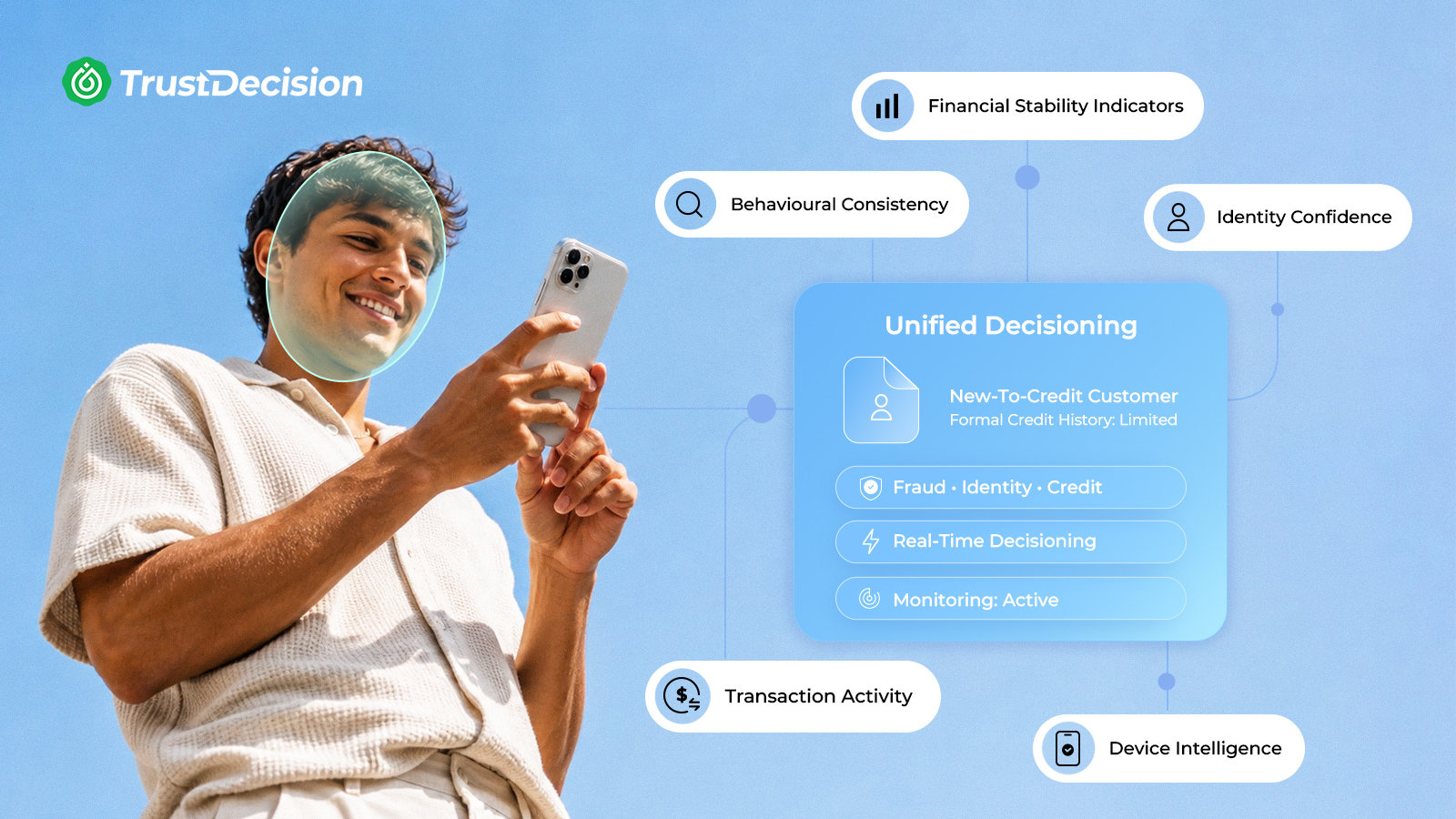
TrustDecision provides an AI-powered credit risk decisioning solution designed to help lenders evaluate applicants accurately, automate credit workflows, and reduce exposure across the customer lifecycle. The platform combines advanced analytics, alternative data, and continuous monitoring to support trustworthy, scalable lending decisions.
Key Features:
- Advanced Credit Data Insight
- High Precision: Achieves strong predictive accuracy with model performance of KS ≥ 0.40, enabling reliable credit scoring across diverse borrower segments.
- Stable Scoring: Ensures long-term consistency with PSI ≤ 0.01, reducing model drift and maintaining dependable risk classification.
- Broad Coverage: Accesses multi-dimensional data covering up to 95% of the population in supported regions, improving the completeness of credit assessments.
- Automated Workflow for Credit Risk Decisioning
- Streamlined Process: Automates essential tasks such as data collection, validation, financial analysis, and credit scoring, significantly reducing manual workload.
- Accuracy & Efficiency: Minimises data entry errors and speeds up decision cycles while maintaining compliance and audit traceability.
- Automated Reporting: Consolidates financial information and risk indicators into comprehensive, ready-to-review credit reports.
- Comprehensive Risk Overview
- Centralised Dashboard: Offers real-time visibility into approval rates, portfolio performance, risk distribution, and key metrics—no coding required.
- Clear Risk Signals: Displays risk tiers, behavioural red flags, and credit score trends to support informed decisions.
- Portfolio-Level Insights: Helps credit teams track delinquency, early warning signals, and risk composition across products.
- Beyond Credit: Insights for Trustworthy Lending
- Holistic Approach: Combines KYC/AML screening, behavioural risk analysis, and credit scoring to provide a multi-layered view of borrower risk.
- Customised Risk Models: Enables institutions to build tailored scoring models for different industries, products, or borrower profiles.
- Global Trusted Intelligence: Supported by experienced engineers and data scientists, leveraging a global intelligence network to intercept cross-market risks.
Explore more on Cutting-Edge Methods for Identity Verification to strengthen identity assurance.
Conclusion
TrustDecision’s Credit Risk Management platform unifies advanced analytics, real-time intelligence, and automated workflows to deliver accurate, consistent lending decisions. With customisable scoring models and configurable strategies, lenders can evaluate creditworthiness effectively across diverse products and markets.
Why It Matters Now
- Markets are increasingly volatile, and borrower behaviour is harder to predict
- Manual reviews cannot keep pace with digital lending demands
- Regulators expect transparent, data-driven credit risk controls
TrustDecision addresses these challenges with high-precision scoring, real-time decision automation, holistic risk insights, integrated KYC/AML safeguards, and support for multi-country lending operations.
Ready to elevate your credit risk strategy?
Discover how TrustDecision enables safer, smarter lending — Book a Demo today.
FAQs:
1. What is credit risk in simple terms?
Credit risk is the chance that a borrower will not repay a loan in full or on time. When this happens, lenders may lose interest income, part of the principal, or incur extra recovery costs. It affects banks, BNPL providers, fintechs, and even B2B companies that offer trade credit to customers.
2. What are the key components of an effective credit risk management strategy?
A strong framework includes:
- Clear risk appetite and exposure limits
- Sound credit-granting standards
- Continuous portfolio monitoring
- Early-warning detection
- Diversification to avoid concentration risk
3. How can AI and data analytics improve credit risk management?
AI enhances risk assessment by providing:
- Dynamic, real-time risk scoring
- Early-warning alerts based on behavioural shifts
- Faster adaptation to market and borrower changes
- Automated insights that reduce manual judgment errors
4. How can smaller lenders or fintechs build a credit risk framework without a large team?
Smaller organisations can start by:
- Standardising credit policies and minimum documentation requirements
- Using simplified scoring models or external credit data where available
- Implementing basic portfolio limits (per customer, industry, region)
- Automating key checks (identity, income, affordability) as early as possible
To move beyond manual spreadsheets and ad hoc rules, many fintechs adopt cloud-based credit risk platforms that offer configurable workflows and pre-built models. TrustDecision’s Credit Risk Decisioning solution is designed specifically to give lean teams enterprise-grade decisioning without building everything in-house.
5. How does TrustDecision’s Credit Risk Management solution support end-to-end credit risk management?
TrustDecision’s Credit Risk Management solution supports the full lifecycle—from loan inquiry and application to disbursement and portfolio monitoring—by:
- Ingesting multi-source data (application, behavioural, alternative credit data)
- Applying configurable rules and scoring models in real time
- Automating approvals, declines, and referrals to manual review
- Feeding back performance data to refine strategies over time
This helps lenders standardise underwriting, reduce manual effort, and maintain consistent risk controls across products and markets. Book a Demo today.
6. What types of data does TrustDecision use to improve credit scoring accuracy?
TrustDecision combines:
- Traditional credit data (repayment history, utilisation, delinquencies)
- Alternative data (digital behaviour, device and session signals, where permitted)
- High-risk list screening and real-time updates to reflect changes in sanctions or negative lists
Our Credit Data Insights and Credit Scoring products are built to increase coverage and predictive power, helping lenders assess thin-file or new-to-credit customers more accurately.
7. Can TrustDecision help with both fraud prevention and credit risk control?
Yes. TrustDecision is designed to handle fraud, credit risk, and compliance in a unified way:
- Fraud Management: The fraud management solution uses device intelligence, behavioural biometrics, and adaptive scoring to block high-risk activity in real time.
- Credit Risk Decisioning: The credit engine assesses affordability, probability of default, and portfolio impact before approving credit lines.
- Identity Verification (eKYC): The Identity Verification (eKYC) solution strengthens identity checks to keep synthetic and high-risk profiles out of the portfolio.
Together, these layers enable lenders to approve good customers safely, minimising both fraud loss and credit loss.
8. Is TrustDecision suitable for banks and fintechs operating across multiple countries?
Yes. TrustDecision is built for institutions that operate across APAC, MENA, and LATAM and need to adapt to different regulations, data sources, and risk profiles.
Key advantages include:
- Configurable strategies per country, product, and customer segment
- Support for multi-currency and cross-border use cases
- Integration with local KYC data sources and device intelligence where available
Explore relevant examples and results in TrustDecision case studies, or Book a Demo today.