Key Takeaways
- Application fraud blends first-party, third-party, and synthetic identity schemes, using stolen, falsified, or synthetic data to open accounts, secure loans, or access financial services across credit cards, BNPL, lending, and digital onboarding.
- One of the fastest-growing fraud types globally, driving multi-billion-dollar losses and exploiting mobile-first, instant-approval flows across APAC, EMEA, and LATAM.
- Fraudsters often build credibility over time, then “bust out” with rapid cash-outs and multi-account schemes, leaving lenders, merchants, and consumers with significant financial losses and eroded trust in digital channels.
- Traditional, rules-only onboarding checks struggle to detect complex identity abuse and synthetic profiles and tend to generate high false positives, overwhelming manual review teams and hurting customer experience.
- Effective application fraud detection requires early, multi-signal analysis of identity, device, behaviour, and cross-channel patterns—combining document and biometric verification, device intelligence, risk scoring, and machine learning.
- Robust prevention relies on a layered defence: strong internal security, continuous transaction and behaviour monitoring, industry-specific risk models, cross-channel analytics, and integrated KYC/AML controls.
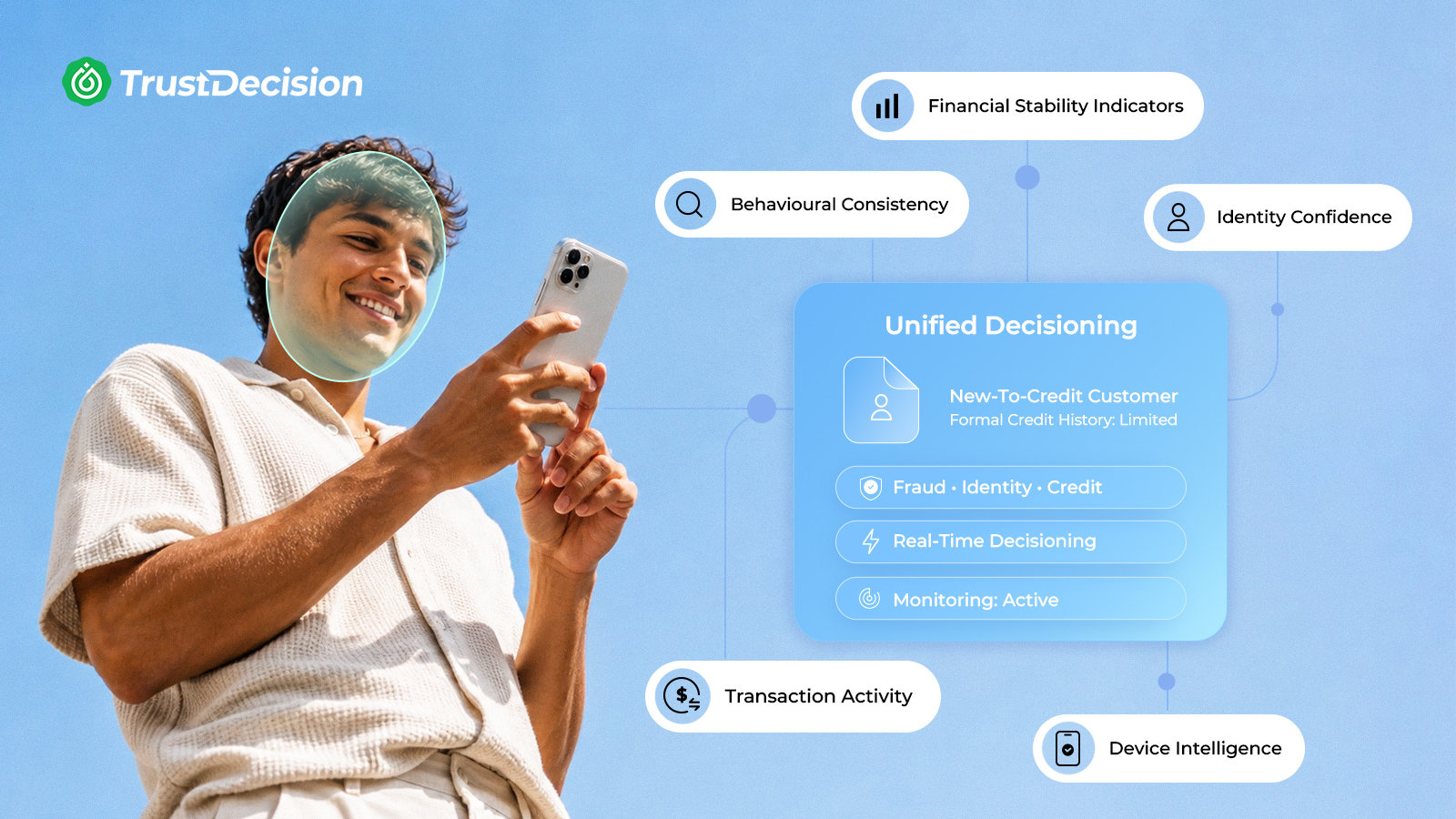
- TrustDecision’s Application Fraud Detection and Fraud Management solutions unify eKYC, device and behavioural intelligence, adaptive ML, and workflow automation to block high-risk applications in real time while keeping onboarding smooth and low-friction for genuine customers.
Understanding Application Fraud
What is Application Fraud?
Application fraud occurs when fraudsters use stolen, falsified, or synthetic information to open accounts, secure loans, or gain access to financial services under false pretenses. These tactics are widely used across credit card onboarding, lending flows, BNPL approvals, and digital account registrations.
Common examples include:
- Identity theft: Using stolen personal information to apply for accounts or credit.
- Credit application fraud: Submitting falsified details (income, employment) to obtain loans.
- Account takeover disguised as new applications: Using compromised info to open linked accounts and drain funds.
Global fraud losses are rising sharply, with identity-related fraud affecting over USD 33 billion in global card losses in 2022. Synthetic identity fraud alone generated USD 35 billion in losses in 2023, making it one of the fastest-growing fraud categories in digital lending.
As these threats evolve in scale and sophistication, the next challenge is understanding why detection must begin early in the onboarding journey.
Why Is Application Fraud Detection Important?
Application fraud detection is essential as fraudsters continually evolve their methods—leveraging stolen data, synthetic identities, automation, and cross-border coordination to bypass onboarding controls. As digital applications continue to grow rapidly, businesses must detect threats earlier and more accurately to protect both revenue and reputation.
1. Evolving Fraud Tactics Across Regions
Fraud rings in APAC, MEA, and LATAM exploit mobile-first onboarding, instant approvals, and eKYC flows. Without strong application fraud detection, organisations remain vulnerable to large-scale synthetic identity attacks and coordinated bot-driven submissions.
2. Protecting Customer Trust
Customers expect institutions to safeguard sensitive information. Effective detection reinforces trust, ensuring users feel confident engaging with digital financial services.
3. Safeguarding Financial Stability
These attacks lead to charge-offs, bad debt, operational losses, and higher provisioning. Fraudulent applications can result in significant losses. In Malaysia, online fraud cases surged to RM1.3 billion in losses in 2023, while Indonesia recorded over USD 1.2 billion in cybercrime losses the same year, highlighting how serious the threat has become across ASEAN.Sources:
- Malaysia: Royal Malaysia Police (PDRM), 2023 Cyber Fraud Statistics
- Indonesia: Indonesia National Cyber and Crypto Agency (BSSN), 2023 Annual Cybersecurity Report
4. Strengthening Regulatory & Market Reputation
Regulators increasingly expect robust fraud controls during digital onboarding. Organisations recognised for strong application fraud detection gain competitive advantage—not only by reducing losses but by attracting partners who value security and compliance.
Knowing why detection is critical sets the stage for the next question: how can businesses accurately spot application fraud before losses occur?
How to Detect Application Fraud?
Application fraud is intentionally designed to appear legitimate, often blending authentic data with fabricated or synthetic elements. Detecting it requires a combination of identity analysis, behavioural insight, device intelligence, and cross-channel correlation.
Below are the major fraud patterns and the signals that help uncover them across digital ecosystems.
1. Stolen Identity Applications
Fraudsters use stolen personal information—often sourced from data breaches, phishing, or social engineering—to submit what appear to be legitimate applications.
Red Flags:
- Identity details (name, ID number, address) appear correct but fail behavioural or device checks.
- Applicant has no prior digital footprint or a footprint inconsistent with their age or profile.
- Multiple applications originating from the same device, IP, or location cluster.
- ID documents pass visual checks but fail liveness or biometric matching.
How to Detect:
- Document authentication: ID document OCR + authenticity checks
- Biometrics verification: face match + liveness
- Device fingerprinting: to detect shared devices
- Cross-checking with authoritative identity databases
Learn how device intelligence enhances identity assurance: Device Intelligence.
2. Synthetic Identity Fraud
Synthetic identities combine real (e.g., government ID numbers) with fabricated information. These “new but realistic” identities often bypass traditional checks and slowly build credibility before defrauding institutions.
Across APAC, rising identity-related fraud is documented by the RBI in India, BSSN in Indonesia, and ACCC Scamwatch in Australia — each reporting increased impersonation, identity-misuse, and digital onboarding risks that enable synthetic identity fraud.
Red Flags:
- SSN/ID number belongs to a child, deceased person, or unused number range
- Thin or recently created credit file with no historical activity
- Applicant passes document checks but fails behavioural, device, or data-linking analysis
- Multiple identities linked to the same device, browser, or behavioural patterns
- Rapid application velocity across lenders
How to Detect:
- Cross-identity graph analysis
- Velocity checks (applications submitted within seconds/minutes)
- Verification across telco, utility, or alternative datasets
- Machine learning models trained to identify synthetic patterns
Explore cross-channel identity verification techniques: Identity Verification.
3. Application Manipulation (Income, Employment, Document Fabrication)
Fraudsters alter income, employment, and address details—or upload forged documents—to appear more creditworthy.
Red Flags:
- Income or employment data that does not align with local market norms
- Documents with digital tampering signatures (metadata change, mismatched fonts)
- Address or employer details that cannot be independently verified
- Sudden “perfect” applications with unusually clean, unblemished data
How to Detect:
- Document forgery detection
- Employment/income verification APIs
- Cross-checking with credit bureau + alternative data sources
- Consistency checks across forms, uploaded documents, and behavioural data
4. Layering Techniques & Multi-Account Networks
Layering involves creating complex, multiple layers of transactions and multi-account structures to obscure true origin of funds—common in mule networks and laundering rings.
Red Flags:
- Multiple accounts linked to the same device or network
- Large, rapid transactions immediately after account creation
- Complex fund flows across newly opened accounts
- Behaviour inconsistent with the applicant’s declared profile
How to Detect:
- Cross-account link analysis
- Behavioural analytics
- Risk scoring using machine learning
- AML pattern detection
5. Bust-Out Fraud
Bust-out fraud is one of the costliest forms of application fraud. Fraudsters build a trustworthy profile over months, then rapidly “max out” all available credit before disappearing.
Red Flags:
- Initially strong repayment behaviour followed by sudden utilisation spikes
- Multiple credit applications across institutions within short intervals
- Large credit line draws and cash-equivalent transactions
- Shared devices/IPs across multiple “good” accounts
How to Detect:
- Longitudinal behavioural monitoring
- Transaction velocity rules
- Bureau + alt-data cross-checking
- Early warning ML models trained on repayment–utilisation shifts
This pattern is increasingly prevalent in APAC’s fast-growing consumer credit markets, where new-to-credit borrowers and rapid digital onboarding create opportunities for exploitation.
Beyond detection methods, it is equally important to recognise the behavioural patterns fraudsters use to build credibility before exploiting accounts.
What Are the Key Characteristics of Application Fraud?
Application fraud often follows recognisable behavioural patterns that—when monitored closely—can reveal malicious intent before losses occur.
Building a Solid Reputation
Fraudsters frequently establish a convincing profile long before executing the final scheme. They do this through:
- Identity Manipulation: Using stolen or fabricated identities to create a credible persona with accurate-looking personal details. This helps them pass basic checks and access onboarding systems undetected.
- Gradual Engagement: Starting with small, legitimate transactions or timely repayments to build a trustworthy track record. This slow, low-risk behaviour reduces suspicion and increases future approval chances.
- Social Engineering: Leveraging rapport-building and psychological tactics to gain trust, extract sensitive information, or bypass manual review controls.
This staged approach allows fraudsters to appear as ideal customers—setting up the conditions for a larger exploitation phase. Once this fabricated trust is established, fraudsters transition into the exploitation phase.
Exploiting Credit Lines
Once trust is established, fraudsters strategically apply for multiple financial products across institutions. They immediately execute large transactions, cash advances, or purchases before systems can respond—maximising the financial impact before disappearing.
These schemes leave behind substantial financial and operational damage:
Trail of Losses
These schemes leave behind substantial financial and operational damage:
- Financial institutions face write-offs, higher provisioning, and tighter risk appetite.
- Merchants and platforms suffer chargebacks, operational disruption, and margin compression.
- Consumers lose confidence in digital channels, particularly when they see others fall victim to account takeover or synthetic identity schemes.
In some markets, fraud is now seen as a systemic issue: for example, UK Financial Times reported £1.17 billion in fraud losses in 2024, reflecting persistent criminal activity despite increased investment in prevention.
Prevention and Mitigation Strategies
How Can Businesses Prevent and Mitigate Application Fraud?
To safeguard your business against fraud applications, it’s not enough to rely on manual review or static rules. A layered defence—combining internal controls, analytics, identity verification, and compliance checks—significantly improves detection accuracy and reduces losses.
Robust Internal Controls
- Firewalls and Network Security: Implement firewalls, intrusion detection systems, and strong access controls to protect application portals and back-office systems.
- Antivirus Software: Regularly update antivirus and endpoint protection to block malware used to steal credentials or alter applications.
- Secure Networks: Use secure protocols (such as HTTPS) and encryption to protect data in transit and at rest.
Regular Monitoring
- Financial Statements: Review financial and operational reports for anomalies, such as unusual chargeback rates or unexpected write-offs.
- Bank Accounts: Monitor bank and settlement accounts with alerts for large or unusual transactions.
- Transaction Analysis: Investigate sudden changes in spending, geographic patterns, or login behaviour as potential indicators of application fraud or account takeover.
Customized Risk Models
- Industry-Specific Models: Develop risk models tuned to your industry’s typical customer journey and threat profile, from application submission through first transaction.
- Behavioural Analysis: Track device usage, session velocity, and interaction patterns to flag abnormal behaviour that might indicate bots, mule accounts, or synthetic identities.
Explore how TrustDecision supports this with Application Fraud Detection and Fraud Management.
Identity Verification
- Facial Recognition: Use biometric matching to compare applicant selfies with ID photos.
- Document Verification: Validate ID documents for tampering, template matches, and data consistency across fields and databases.
- Biometric Checks: Fingerprint or other biometric factors add a strong layer against impersonation and repeat offenders.
For deeper onboarding assurance, see Identity Verification and Device Intelligence for cross-device risk signals.
Cross-Channel Analysis
- Multi-Channel Checks: Correlate activity across web, mobile, and call centre to reveal suspicious cross-channel patterns.
- Alternative Credit Data: Use non-traditional data (e.g., utilities, telco, rental history) to spot inconsistencies in thin-file or synthetic applicants.
- Credit Bureau: Cross-check applicant information against bureau records to detect prior fraud markers or conflicting identity elements.
Compliance Checks
- AML (Anti-Money Laundering) Rules: Embed AML scenarios to detect layering and mule behaviour associated with fraud applications.
- KYC (Know Your Customer) Rules: Apply robust eKYC to verify identity, beneficial ownership, and geographic risk before approvals.
Enhance your onboarding assurance with TrustDecision’s advanced eKYC Identity Verification solution.
TrustDecision’s Application Fraud Detection
TrustDecision’s Application Fraud Detection platform is designed to fortify businesses against the ever-evolving risk of fraud applications across banking, fintech, lending, and digital commerce—especially in fast-growing digital markets.
By integrating advanced analytics, device and behaviour intelligence, and eKYC workflows, TrustDecision helps organisations approve genuine customers quickly while blocking high-risk applications in real time.
Key Features
- Sophisticated Data Analytics
- Real-time Data Integration: Continuously monitors incoming application data, enriching it with device, behavioural, and third-party signals. This enables immediate detection of suspicious patterns, such as multiple applications from the same device or network.
- eKYC/Identify Verification: Extends traditional KYC with behavioural analysis, biometrics, and cross-referencing against external databases, helping to identify synthetic identities and repeat fraud attempts.
- Machine Learning Models
- Adaptive Algorithms: Machine learning models evolve as fraud tactics change, learning from confirmed fraud cases and feedback loops. This adaptability is crucial for catching new bust-out schemes, synthetic identity use, and cross-border rings.
- Reduced Operational Costs
- Holistic Applicant Behaviour Analysis: Examines the entire applicant journey—from submission to first transaction—across channels to minimise manual review and focus investigators on the highest-risk cases.
- Streamlined Processes: Automated risk scoring, real-time alerts, and integrated case management reduce manual workload and improve investigation throughput.
Learn more about TrustDecision’s broader ecosystem in Fraud Management and Credit Risk Management for downstream lifecycle controls.
Conclusion — Turning Application Fraud into a Manageable Risk
Application fraud—from stolen identities to synthetic and bust-out schemes—remains a serious threat that can weaken institutions, harm brands, and reduce customer trust.
Effective protection requires layered controls, including:
- Strong internal controls and continuous monitoring
- Behavioural and device intelligence
- Robust identity verification
- KYC/AML compliance checks
TrustDecision’s Application Fraud Detection platform unifies these defences with real-time data integration, adaptive machine learning, and cross-channel intelligence—helping organisations stop high-risk applications early while approving genuine customers faster.
Ready to strengthen your defences against fraud applications?
Explore how TrustDecision’s solutions can help your business stay secure and ahead of emerging risks — Book a Demo today.
FAQs
1. Why is application fraud increasing in digital onboarding?
Application fraud is rising as more lending, banking, and BNPL journeys move fully online and criminals exploit fast, low-friction signup flows. Fraudsters now:
- Reuse breached identity data at scale
- Build synthetic identities that look “creditworthy”
- Automate mass applications using bots and scripts
- Target instant-approval products with light checks
Without layered controls on identity, device, and behaviour, digital channels become an easy entry point for mule accounts and loan abuse. Solutions like Application Fraud Detection and Fraud Management help organisations score and block high-risk applications in real time across these online journeys.
2. What are common red flags of a fraudulent application?
Typical red flags include:
- Inconsistent or obviously fabricated personal information
- The same device, IP address, or contact details used across many “new” customers
- Suspicious ID images (blurred, edited, or mismatched details)
- Disposable or newly created email and phone numbers
Multiple weak signals appearing together usually indicate a higher-risk application.
3. How is application fraud different from account takeover?
- Application fraud involves creating a new account using fake, stolen, or synthetic identity data.
- Account takeover (ATO) involves hijacking an existing account using stolen credentials or social engineering.
Both should be addressed within a unified fraud management strategy that covers onboarding and post-login activity.
4. How can businesses reduce application fraud without adding too much friction?
The most effective approach is risk-based, layered verification:
- Keep low-friction journeys for low-risk applicants
- Add step-up checks (document verification, biometrics, extra questions) only when risk scores are high
- Use ongoing post-onboarding monitoring to catch early misuse
Pairing strong onboarding controls with continuous monitoring and credit risk checks helps balance fraud prevention and customer experience.
5. How does TrustDecision detect and prevent application fraud?
TrustDecision’s Application Fraud Detection solution uses advanced analytics and real-time data integration to score each application as it’s submitted, detecting fake registrations, identity fraud and loan stacking before accounts are opened.
High-risk applications can be blocked, stepped up for additional checks, or routed to manual review, reducing losses and investigation workload.
6. What data signals does TrustDecision analyse to spot risky applications?
TrustDecision combines:
- Identity and eKYC data (ID, name, address, phone, email consistency) via its eKYC/Identity Verification solution
- Device intelligence and fingerprinting
- Behavioural and session patterns, IP and network relationships, and historical fraud links
This multi-layer design makes it much harder for synthetic or stolen identities to slip through at onboarding.
7. Can TrustDecision protect the full customer journey beyond the initial application?
Yes. TrustDecision’s Fraud Management solution provides cross-channel, real-time fraud detection across mobile apps, web, ATMs, POS and branches, while Account Protection focuses on login and session risk to prevent account takeover.
Together, they protect users from sign-up to transaction, not just at the application stage.
8. How can my team get started with TrustDecision’s application fraud solution?
You can explore the capabilities of Application Fraud Detection and Fraud Management, then book a demo to discuss your onboarding flows, data sources, and target markets with TrustDecision’s experts.
This helps you design a rollout plan that starts with your highest-risk products and scales across regions as results are validated.